
A persistent theme in our “Sustainability Insights” essays during the last three years has been that universities have a great deal of unrealized potential to help solve urgent, important societal problems. In this last post before I retire, I describe how we at Cornell Atkinson are helping Cornell University realize its potential more than ever in the overlapping domains of climate, energy, food, and health. It is my hope that our experience at Cornell may inform like-minded leaders at other universities as they further develop interdisciplinary university-based centers and institutes with a focus on external impact; and that leaders in corporations, NGOs, and government agencies will look to Cornell and other research universities as potential co-creators of research agendas that will result in public benefit via goods and services provided by the private and/or public sectors.
The State of University Research & Public Trust
In a past post, I wrote that to make research more immediately useful, universities “need to create incentives for research transcending traditional disciplines,” adopt a “more humble attitude to enable collaboration with those without Ph.D.s,” and build “long-term strategic partnerships with non-university organizations that can help guide research and increase the scale of its application to solve real-world problems” (July 2023). And I’ve written that while many universities have invested in technological innovation and commercialization, the power of which was quantified in a recent Science article on Pasteur’s quadrant research, “few analogous efforts support the research and collaboration needed for innovations in corporate practice and government policy that, alongside technological innovation, are essential to solving society’s more wicked … problems like climate change” (November 2023).
I’ve also noted the decline in public trust in universities, which is linked to the perceived usefulness of research. Although only 68% of people have a “great deal/quite a lot” or “some” confidence in higher education, much greater proportions believe that universities are “somewhat” or “very important” for technology (91%), science (90%), healthcare (83%), and economic growth (83%), according to the October 2025 report from Higher Education Barometer. Clearly, the public appreciates the role university research plays in finding solutions to societal needs, suggesting that universities could increase public trust by further incentivizing useful research. Land-grant universities like Cornell are particularly well positioned to do this.
How We Accelerate Our Research-to-Impact Mission
New York Outcomes Fund
In collaboration with a statewide network
of partners, our New York Outcomes Fund is
accelerating the adoption of regenerative
agriculture in New York’s Lake Ontario
watershed.
In Cornell Atkinson’s flagship Innovation for Impact Fund, we act like a small foundation. Led by our partnerships team, which Patrick Beary directs, we fund Cornell researchers to work on co-created projects with collaborators supported by their home organizations (NGOs, corporations, or other private and public sector organizations). The impact we are after is to have Cornell research inform public opinion, corporate practices and products, or government policies.
As we’ve refined our goals and processes and broadened our partnerships over the last seven years, we’ve gotten more successful. For projects that were initiated at least two years ago, 90% are achieving at least one desired impact, with impacts attained in all four target categories: public opinion (64%); corporate practice (45%): products (36%); and public policy (64%). Of course, many (83%) of these projects also had positive spillover impacts on the curriculum or other educational programs.
In the table below, I provide one example each of projects across our four impact categories and our four priority areas of research. At the bottom of this essay, you will find a key with web links to fuller descriptions of each of these projects.
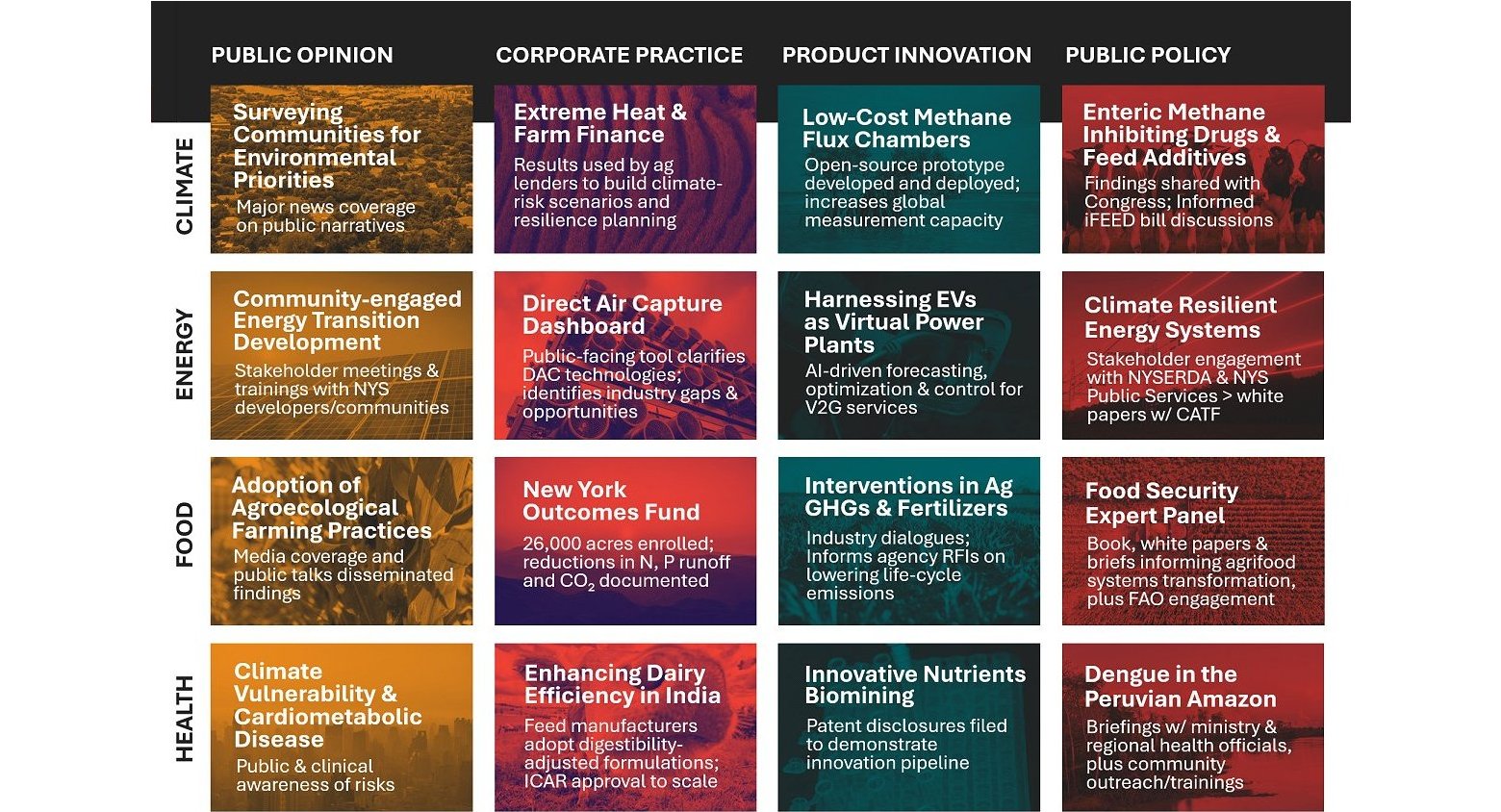
I provide these specific examples, fully aware that Cornell Atkinson’s optimism and call to partnership may seem out of place in the bubbling ferment of nationwide discussions about the future of U.S. universities.
The Way Forward: Finding the Middle Ground
Student-built Methane Sensor Aids
Mangrove Restoration Efforts
A team of Cornell students and faculty, in
partnership with EDF, created a device to
measure methane from water bodies, as a
tool in the fight against climate change.
Two widespread and strongly held positions are, at least in their most extreme manifestations, contradictory. The recent report from Yale University’s Committee on Trust in Higher Education can be read, as Wesleyan University’s President Michael Roth read it, as a call from a defensive crouch to prune back the mission of universities to a liberal arts oriented creation and dissemination of knowledge, eliminating what Yale’s committee saw as mission creep formed in left-leaning echo chambers, and what Roth sees as a retreat from public purpose.
At the opposite extreme, others call for more fully embracing the role of universities as agents of social, cultural and political change, often around a single issue like climate and usually in the politically leftward direction. In this model, universities are advocacy organizations and individual faculty are activists, as recommended in the March 2026 report “Climate Action in Higher Education: Roadmap.”
As Cornell Atkinson’s work illustrates, I think there’s a middle ground.
As I’ve argued in a previous post, a restoration of some sort of pluralistic liberal arts core curriculum is required as a centripetal force to counteract the centrifugal force of specialization, which requires such deep and narrow intellectual dives that even faculty in neighboring disciplines no longer have a common language. The restoration of an intellectual public square within universities would enable all students to explore different value systems that shape character, private commitments, and public virtues.
On the other hand, the restoration of an intellectual public square should not crowd out specialized research pursuits that foster so much technical and conceptual innovation that drives economic growth and productivity, which, at its best, increases human thriving. Rather, the discussions and commitments formed in the public square should inform how students and faculty go about their more specialized scholarly work. Both aspects are necessary to enable universities to better serve society, with the exact strategy of each university contingent on unique institutional histories.
At Cornell Atkinson, we embrace partnerships with nonacademic organizations, because diverse perspectives and complementary expertise produce better research agendas and a higher likelihood of serving society. The power of partnerships through Cornell Atkinson is one way that Cornell University brings research to positive impact for society.
Key for Cornell Atkinson Impact Matrix:
|
Public |
Corporate |
Product |
Public |
|
|
Climate |
Surveying Communities for Environmental Priorities Major news coverage on public narratives |
Extreme Heat & Farm Finance Results used by ag lenders to build climate-risk scenarios and resilience planning |
Low-Cost Methane Flux Chambers Open-source prototype developed and deployed; increases global measurement capacity |
Enteric Methane Inhibiting Drugs & Feed Additives Findings shared with Congress; Informed iFEED bill discussions |
|
Energy |
Community-engaged Energy Transition Development Stakeholder meetings & trainings with NYS developers/communities |
Direct Air Capture Dashboard Public-facing tool clarifies DAC technologies; identifies industry gaps & opportunities |
Harnessing EVs as Virtual Power Plants AI-driven forecasting, optimization & control for V2G services |
Climate Resilient Energy Systems Stakeholder engagement with NYSERDA & NYS Public Services > white papers w/ CATF |
|
Food |
Adoption of Agroecological Farming Practices Media coverage and public talks disseminated findings |
New York Outcomes Fund 26,000 acres enrolled; reductions in N, P runoff and CO₂ documented |
Interventions in Ag GHGs & Fertilizers Industry dialogues; Informs agency RFIs on lowering life-cycle emissions |
Food Security Expert Panel Book, white papers & briefs informing agrifood systems transformation, plus FAO engagement |
|
Health |
Climate Vulnerability & Cardiometabolic Disease Public & clinical awareness of risks |
Enhancing Dairy Efficiency in India Feed manufacturers adopt digestibility-adjusted formulations; ICAR approval to scale |
Innovative Nutrients Biomining Patent disclosures filed to demonstrate innovation pipeline |
Dengue in the Peruvian Amazon Briefings w/ ministry & regional health officials, plus community outreach/trainings |
Header photo: Cargo ships docked at San Juan on the Ucayali River, Peru (source: Kara Fikrig)
Learn more about David M. Lodge