2025: AI-Enabled Synthesis of Bespoke Unconventional Solar-cell Materials
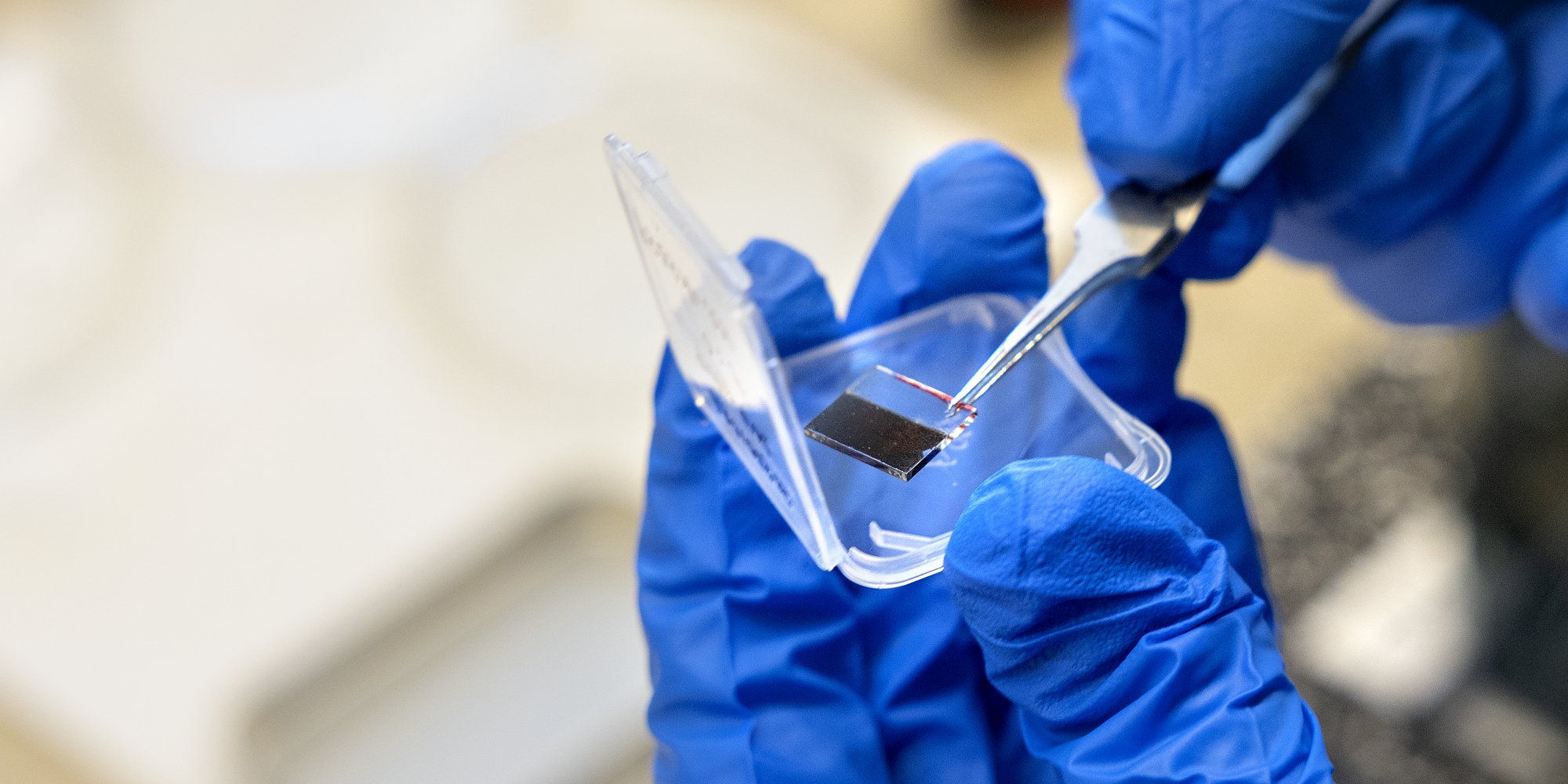
The vast majority of solar infrastructure relies on silicon solar cells. However, alternative materials like lead-halide perovskites are comparatively more defect tolerant and are estimated to cost less than quarter as much to produce. More than a dozen companies in the U.S. are currently pursuing perovskite commercialization. This project seeks to use artificial intelligence and machine learning to accelerate the translation of lead-halide perovskite solar cell materials from the lab to the factory. This project builds on two recent breakthroughs at Cornell. The first, by the teams of John Marohn and Roger Loring in Chemistry and Chemical Biology, is the invention of unique scanning-probe metrology tools for quantifying the electronic and ionic conductivity, charge density, and dielectric constant of thin semiconductor films. The second breakthrough, by Michael Lawler’s team in Physics, is the application of large-language models to optimize the growth of materials. In this project, researchers will carry out proof-of-concept experiments demonstrating that Lawler’s novel transformer-models enable the synthesis of lead-halide perovskite films with good film coverage, large grains, and, for the first time, well-controlled and reproducible ionic and electronic conductivity.
Investigators: John Marohn and Michael Lawler, both Arts & Sciences